Wednesday, February 11, 2009

Recession and the Debt


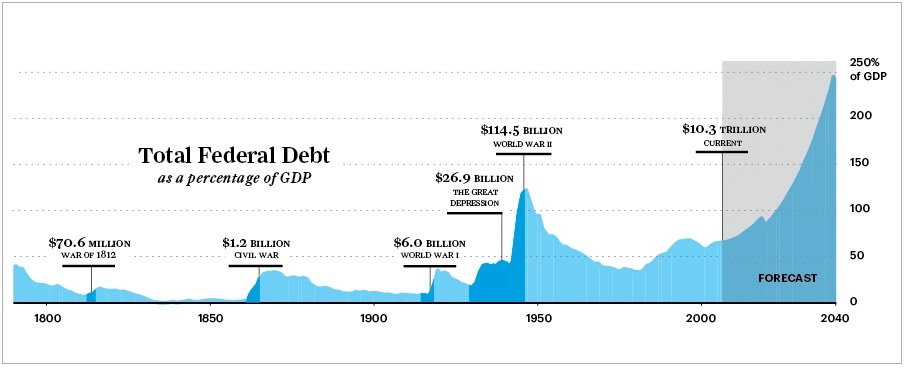
I found this chart of the Federal Debt as a percentage of GDP on Condé Nast Portfolio.com. It's about three months old, and I'm not sure what the massive future increase is based on.


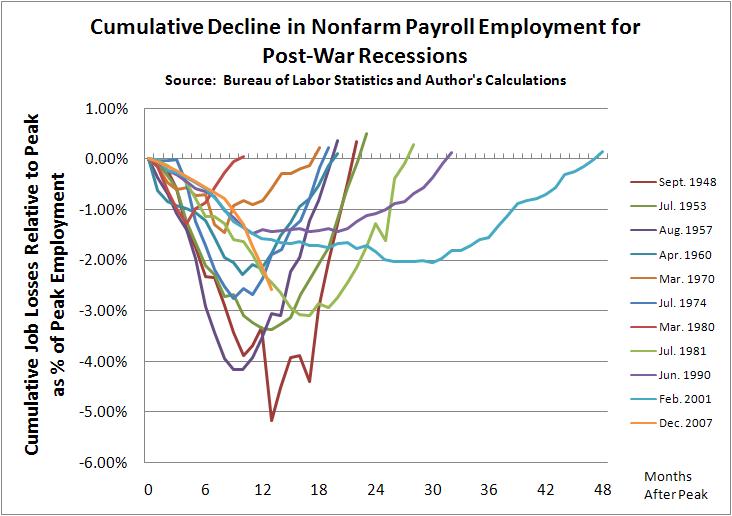
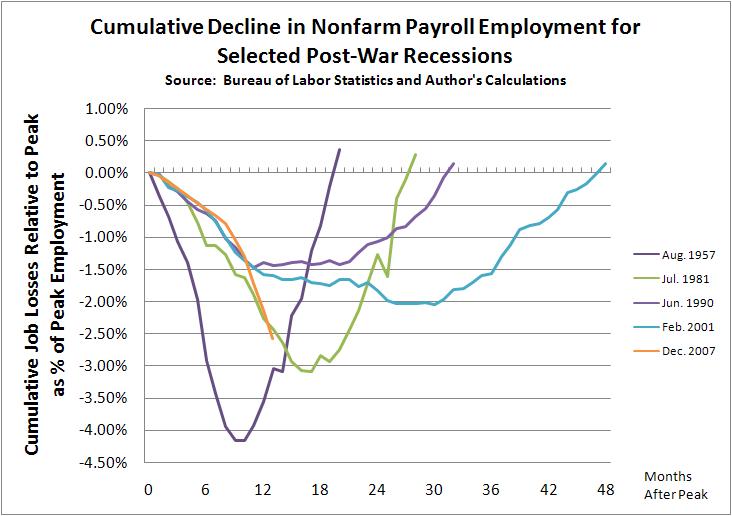
Here are two charts showing the duration and percentage decline in employment for recessions since WWII—i.e., since, but not including the Great Depression—from the maximum pre-recession levels.


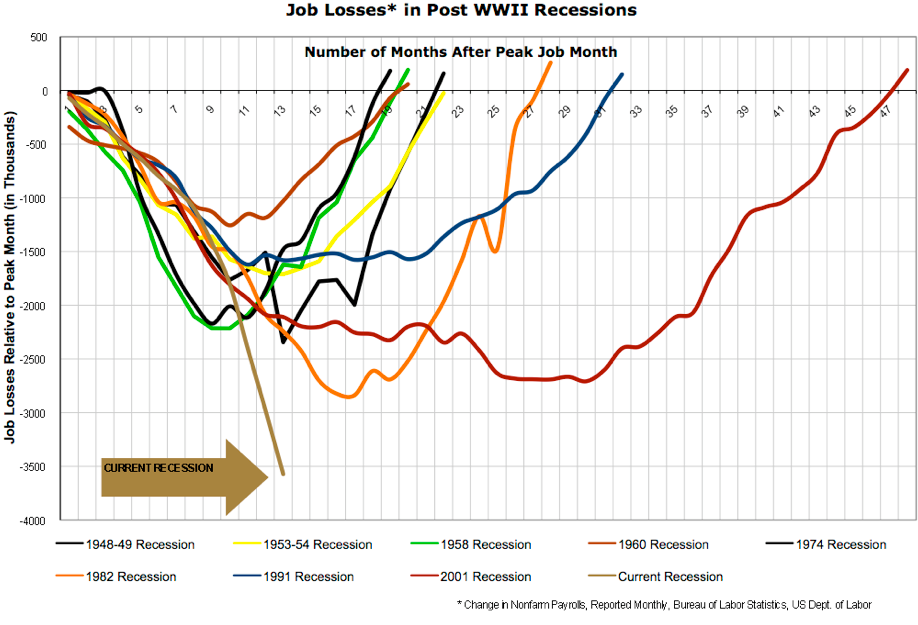
The next chart is slightly different, showing the number of jobs lost, rather than the percentage. Since the population and economy have both been growing since WWII, the current recession effects more jobs and people than earlier, but similarly deep, recessions.

Wednesday, December 17, 2008

Other Voices


Leigh Caldwell on his Knowing and Making blog, provides some analysis of How Much Blagojevich SHOULD have asked for?  After all, how much is a U.S. Senate seat worth? And what is the discount for the risk of discovery?

We've all grown pretty accustomed to obfuscation, and outright lying from our political leaders and other's trying to sell us something. So which economists should we trust when it comes to understanding our current financial crisis with all the money being handed out? Need help? Check out the Economist Rankings at IDEAS. Let's see, Paul Krugman is ranked 15th. Nuriel Roubini is 403rd! (Hmm, maybe I'd better stop listening to him.) Larry Summers is 12th. Good. Glad I don't have to worry about that anymore! I forgot to mention, Joseph Stiglitz is ranked number one.

One more voice I want to recommend is that of Jeffrey Sachs. I particularly liked his article on the American Anti-Intellectual Threat, published in September on Project Syndicate.

Saturday, December 13, 2008

a Trillion Here, a Trillion There...


(updated below)

It's hard for me to wrap my mind around the dollar amounts involved in the financial rescue/bailout. In one sense, they're just numbers. But the thing that's finally gotten me thinking about how much money we're talking about, is thinking about the discussions we used to have about the money being spent on the war in Iraq.

In addition to lives and families lost and wrecked, we mourned the better uses that money could have been put to—universal healthcare, energy independence. (Never mind that the money we spent in Iraq was borrowed and wasn't really available for alternative projects.) But now, compared to the money we're giving financial institutions, that amount pales.

The above is already out of date.  The $4.6 trillion was as of November. (From The Big Picture. by way of mindtangle.) I've seen the figure estimated as high as $7.4 trillion. Every day, that number will be more and more out of date. Wait, here's yet a higher number already!
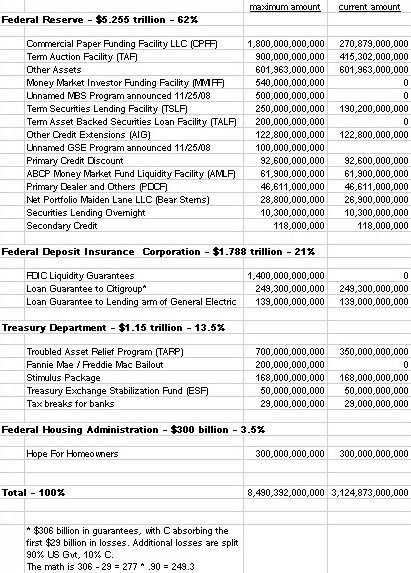
I am going to have to find some time when I can quiet my mind and try to find an explanation for what happened that requires all this money to fix. (I expect the place to start may be Wikipedia's article on the Subprime Mortgage Crisis Housing Bubble.)

UPDATE: I want to add a couple of links I found trying to put the cost of the Iraq War in perspective. The first, is a graph comparing Iraq war spending vs. spending on renewable energy from Solar Power Rocks! (The chart is too big to fit on this page!) Another link, from Ted Kennedy, put's the Real Cost of the War in Iraq in perspective by comparing the cost of one day of war expenditures to what that money could buy.

Sunday, December 7, 2008

Car Bombs!


Here's an idea! We buy up a bunch of cars from the Big Three automakers, load them up in bombers, and drop them on our enemies in Iraq and on the Afghanistan-Pakistan border—car bombs!

The cars that aren't completely destroyed when they fall on the terrorists—they can fix up and drive. This will help promote our modern way of life—and they'll have to build roads and buy spare parts from our auto parts stores! We bail out the auto industry, kill some terrorists, and spread good old American Capitalism! Everybody wins! (Except for the evil terrorists, of course.)

I mean, we're going to have to do something with all the cars Detroit will be making. We could condition the bailouts on not building cars—like agriculture subsidies, where we pay the farmer not to grow their crop this year. But, the problem with this is that it doesn't help the dealerships or the industries that supply the parts and materials to make the cars. To solve the economic problem of the automakers—and all those other businesses—we have to come up with a solution where they keep making cars.

So, if we're not going to have the military buy them up and drop them out of bombers, what are we going to do with them. I guess the government could buy them and give them away to people who deserve a new car, but just can't afford to buy one. (But that sounds like a potentially serious ethical conundrum!)  

I know! We can give them to veterans! Or, we can give them to people who're homeless, 'cause they defaulted on their subprime mortgages. There might be some retooling required—like making sure the seats will lie flat for sleeping. (While we're at it, we could replace the cigarette lighters with toilet paper holders.)

If none of these ideas succeeds maybe we can at least give tax credits to people for buying American-made cars. Like we did for energy efficient vehicles through the Energy Policy Act of 2005. (Unless there's some anti-protectionism rule against helping American automakers.) Plus, we could ease the credit blockage by offering some kind of guarantee to banks making the loans to the people buying the cars.

Saturday, December 6, 2008

Suspicious Statistics


Paul Krugman has a chart from the U.S. Department of Labor, Bureau of Labor Statistics showing the ratio of civilian employment to population (EMRATIO) on his Conscience of a Liberal blog today.

"The chart above shows the employment-population ratio,  the ratio of employed Americans to the adult population. By this measure it’s been a weak economy all along — and now it’s falling off a cliff."
One of the first things that strikes me about this graph is the range of employment percentage (Y-axis). If the chart showed the percentage fluctuation in the context of zero to one hundred percent employment, the variation would look pretty minimal. And why are we looking at only ten years?

So I went out to the Federal Reserve Bank of St. Louis website to see what else I could find.  Sure enough, here's the same chart, but showing employment since the 1940's.

This picture seems to tell a different story! But now you have to take into account that women were joining the workforce in greater numbers during this period.  (In fact, given the relatively narrow percentage range, I surprised the increase isn't greater.)

Here's another period to look at—the last two administrations.

What do you think? Do Clinton and the Democrats get credit for the first half of the period? The Republican congress? Do Bush and the Republicans get the blame for the last half? Whose fault were the two burst bubbles?

So, I started this suspicious of Dr. Krugman for cherry-picking data to support his position. After thinking about it, I'm not so suspicious of him. I'm suspicious of statistics! It's not trivial to avoid making them say what you want them to say.

Friday, November 28, 2008

Wandering Wikipedia: Financialization


Barreling along the road of life with only low beams for illumination, today's headlines replace yesterday's and yesterday's problems are soon replaced with today's. The economic crisis gets replaced, if even for a short time, by terrorist attacks in Mumbai. Top stories of the day seem to demand equal attention, whether it's a child kidnapping or the end of the world as we know it.

A meeting between Treasury Secretary Hank Paulson and Federal Reserve Chairman Ben Bernanke with congressional leaders on the evening of September 18 placed the current financial crisis squarely in the nation's headlights! Congressional leaders were stunned! Senators gulped! Paulson had a plan, but we had to move fast! He needed $700 billion and he needed it now! The original language stated: "Decisions by the Secretary pursuant to the authority of the Act are non-reviewable and committed to agency discretion, and may not be reviewed by any court of law or any administrative agency." Whoa!

Paulson's plan was only three pages long. We were in crisis mode. But why?

The other day I was browsing through old podcasts of On Point with Tom Ashbrook.  I found one from January 23, 2008, Global Market Meltdown?, with guests Jeffrey Frankel, Robert Kuttner, Philip Coggan and Amit Seru.  This conversation followed two days of turmoil in the stock market and a three quarter percent cut in the federal funds rate. Kutter, co-founder and co-editor of The American Prospect magazine, who had been predicting a tough recession for months, told Ashbrook that "this was a needless recession, caused by excessive financial engineering that now has led to serious damage to the balance sheets of large financial institutions which then cascades into the rest of the economy." A month earlier he had written an article, The Solvency Crisis, for the American Prospect, where he referred to the unfolding crisis as a "perfect economic storm". He wrote: "Ours is a resilient nation. The eventual recovery will require a repudiation of free-market economics, as bold as the New Deal."

So why, in September 2008, were we in what seemed to be such a reaction mode? I decided to go wandering through Wikipedia for some answers.

The subprime mortgage crisis had lead to the global financial crisis of 2008, and beyond the financial markets to the global economic crisis of 2008! But, this has been coming since before January, 2008 (the financial crisis of 2007-2008). It was at about this point that I was introduced to the term, financialization.

Wikipedia tells us that financialization "is a term used in discussions of a form of capitalism which developed over several decades leading up to the 2007-2008 financial crisis, and in which financial leverage and exotic financial instruments tended to override capital (equity), and financial markets tended to dominate over the traditional industrial economy." We've been hearing about some of these financial instruments in the news recently, like mortgage-backed securities (MBS) and collateralized debt obligations (CDO). (The Wall Street Journal has a nice set of explanatory graphics, The Making of a Mortgage CDO, as does Portfolio.com.) And let's not forget credit default swaps (CDS)!

The article on financialization includes the following quote from Financialization and the World Economy, editor Gerald A. Epstein.

"in the mid- to late 1970s or early 1980s, structural shifts of dramatic proportions took place in a number of countries that led to significant increases in financial transactions, real interest rates, the profitability of financial firms, and the shares of national income accruing to the holders of financial assets. This set of phenomena reflects the processes of financialization in the world economy . . .

". . . finance benefits handsomely from the same processes that create economic crises and injure so many others. Hence the costs of financial crises are paid by the bulk of the population, while large benefits accrue to finance. Duménil and Lévy provide new and valuable data documenting these trends in the case of France and the USA . . .

"Using the case of the US economy, Crotty argues that financialization has had a profound and largely negative impact on the operations of US nonfinancial corporations. This is partly reflected in the increasing incomes extracted by financial markets from these corporations; trends identified also by Duménil and Lévy and Epstein and Jayadev. For example, Crotty shows that the payments US NFCs paid out to financial markets more than doubled as a share of their cash flow between the 1960s and the 1970s, on one hand, and the 1980s and 1990s on the other . . .

"Financial markets’ demands for more income and more rapidly growing stock prices occurred at the same time as stagnant economic growth and increased product market competition made it increasingly difficult to earn profits. Crotty calls this the ‘neoliberal’ paradox. Non-financial corporations responded to this pressure in three ways, none of them healthy for the average citizen: 1) they cut wages and benefits to workers; 2) they engaged in fraud and deception to increase apparent profits and 3) they moved into financial operations to increase profits. Hence, Crotty argues that financialization in conjunction with neoliberalism and globalization has had a significantly negative impact on the prospects for economic prosperity."

And this is going to cost us how much to fix?

According to Wikipedia, the end of the post-WWII Bretton Woods system of fixed international exchange rates and the decoupling of the U.S. dollar to gold in 1971 were significant impetuses to the rise of financialization.

Another, possibly more significant, contributing factor was the Commodity Futures Modernization Act of 2000. This bill repealed the ban on single-stock futures and deregulated credit default swaps. The bill was introduced in the House on December 14, 2000, and in the Senate on the following day - just prior to the Christmas break. There were no hearings and no debate. Republican leadership incorporated this act, H.R.5660, by reference into the 11,000 page long omnibus bill, The Consolidated Appropriations Act for FY2001. Both Republicans and Democrats overwhelming supported this budget bill, the Senate passed it by unanimous consent, and President Clinton signed it into law on December 21, 2000.


This is going to cost a lot of money to fix. And it's not enough to just get the old system running again. On September 26, French President Nicolas Sarkozy, currently also the President of the European Union, said "We must rethink the financial system from scratch, as at Bretton Woods."[*] On October 13, British Prime Minister Gordon Brown said: "We must have a new Bretton Woods, building a new international financial architecture for the years ahead."[*] The latest step toward a new financial system was the G-20 Leaders Summit on Financial Markets and the World Economy, on November 14-15, 2008, in Washington, D.C.

It will be interesting to see what happens.

...subject to revision...

Friday, November 21, 2008

Rescue the Automakers?


Should congress give the Big Three automakers $25 billion to try to stave off bankruptcy? How should I know! There are too many unknowns for me to be able to construct an informed opinion. By the time I do enough research to begin to figure out what's really going on, we will have moved on to the next issue. I just hope the people making the decisions in Washington know what they're doing.

I've watched excerpts from a couple of congressional hearings where our representatives criticize the automaker CEOs for coming to Washington in separate private jets. (Is this like not wearing a flag lapel pin? Is this really about political correctness?) Everyone seems pretty down on these executives, as if they're personally responsible for driving their companies into the ground. Are they? Have they? Or, are we just mad that they make so much money?

Maybe they just make the cars people want to buy. It's certainly true that they can't build a 'green' car that people don't want and sell it at a price people aren't willing to pay. Or maybe they spend the big advertising bucks to convince us that we want to buy the cars they want to make. Is it that they aren't building the cars that people want to buy? Or, is nobody buying cars? 

For the sake of argument, let's say nobody's buying cars. If that's the case, what do we expect from our automakers? Do we expect them to hibernate until we get past this recession, or at least past the credit crunch? Should they be crushed by the Invisible Hand of the Free Market or are they too big to fail?

Chapter 11 is supposed to handle situations where a business has just gotten in over its head and, if reorganized, can get back on its feet. But, if none of the car companies are selling cars how would reorganization help? Some say people won't buy a car from a bankrupt company and that, Chapter 11 would lead to Chapter 7, and that would be the end of the company, causing a domino effect through all the other companies that are linked by doing business together - millions of people out of work! Are these companies too big to fail?

What does that mean for a company to be too big to fail? Does it mean the United States government must guarantee its survival? If that's the case, this has got to work in some way other than these companies just coming to us for money whenever things don't go their way. I'm not sure these CEOs have even brought a plan with them to show how this $25 billion is going to help.

If a company is too big to fail and the taxpayers are going to be responsible for rescuing it when it gets into trouble, then I expect my government to do everything it can to make sure it doesn't get in trouble. This means regulations and oversight, maybe not allowing a company to get to the point where its that important.

For a guy who started out saying he didn't know enough to have an informed opinion, here I am talking about government regulation of big business like I was some kind of expert! You know how pretty soon after the polls close on election night, the networks announce that, "with one percent of the votes counted, we're calling the election for Joe Blow", or whomever? When I start thinking I can solve the automakers' problems, there ought to be a little announcer in my head saying "with one percent of the facts in, we're declaring the solution to be..."

I can't help but have lots of uninformed opinions. People who reinforce what I already think look smart; those who disagree make me uncomfortable. But I think I'm going to have to rely on my representatives in Washington to figure out what to do.  

One more thing. Conservatives, opposed to government action in response to this crisis, who justify their objections using axioms or aphorisms, are not persuasive. These platitudes oversimplify the situation in order to make it easier to understand and to justify the use of stock responses. It's important that we deal with the the entire complexity of problems that confront us, not symbolic caricatures that only capacitate the ideology of one segment of society.