Wednesday, December 17, 2008
Other Voices
Saturday, December 13, 2008
a Trillion Here, a Trillion There...
In addition to lives and families lost and wrecked, we mourned the better uses that money could have been put to—universal healthcare, energy independence. (Never mind that the money we spent in Iraq was borrowed and wasn't really available for alternative projects.) But now, compared to the money we're giving financial institutions, that amount pales.
The above is already out of date. The $4.6 trillion was as of November. (From The Big Picture. by way of mindtangle.) I've seen the figure estimated as high as $7.4 trillion. Every day, that number will be more and more out of date. Wait, here's yet a higher number already!
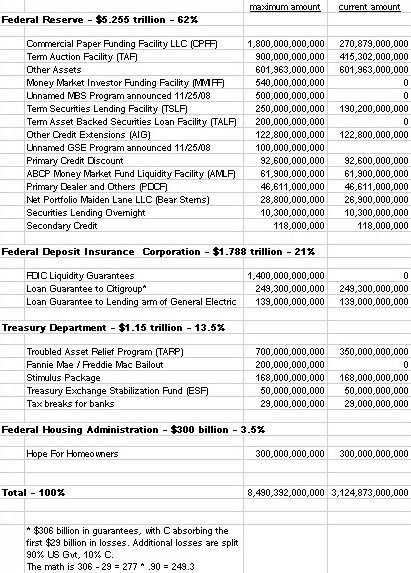
I am going to have to find some time when I can quiet my mind and try to find an explanation for what happened that requires all this money to fix. (I expect the place to start may be Wikipedia's article on the Sunday, December 7, 2008
Car Bombs!
The cars that aren't completely destroyed when they fall on the terrorists—they can fix up and drive. This will help promote our modern way of life—and they'll have to build roads and buy spare parts from our auto parts stores! We bail out the auto industry, kill some terrorists, and spread good old American Capitalism! Everybody wins! (Except for the evil terrorists, of course.)
I mean, we're going to have to do something with all the cars Detroit will be making. We could condition the bailouts on not building cars—like agriculture subsidies, where we pay the farmer not to grow their crop this year. But, the problem with this is that it doesn't help the dealerships or the industries that supply the parts and materials to make the cars. To solve the economic problem of the automakers—and all those other businesses—we have to come up with a solution where they keep making cars.
Saturday, December 6, 2008
Suspicious Statistics
"The chart above shows the employment-population ratio, the ratio of employed Americans to the adult population. By this measure it’s been a weak economy all along — and now it’s falling off a cliff."
So I went out to the Federal Reserve Bank of St. Louis website to see what else I could find. Sure enough, here's the same chart, but showing employment since the 1940's.
Friday, November 28, 2008
Wandering Wikipedia: Financialization
"in the mid- to late 1970s or early 1980s, structural shifts of dramatic proportions took place in a number of countries that led to significant increases in financial transactions, real interest rates, the profitability of financial firms, and the shares of national income accruing to the holders of financial assets. This set of phenomena reflects the processes of financialization in the world economy . . .
". . . finance benefits handsomely from the same processes that create economic crises and injure so many others. Hence the costs of financial crises are paid by the bulk of the population, while large benefits accrue to finance. Duménil and Lévy provide new and valuable data documenting these trends in the case of France and the USA . . .
"Using the case of the US economy, Crotty argues that financialization has had a profound and largely negative impact on the operations of US nonfinancial corporations. This is partly reflected in the increasing incomes extracted by financial markets from these corporations; trends identified also by Duménil and Lévy and Epstein and Jayadev. For example, Crotty shows that the payments US NFCs paid out to financial markets more than doubled as a share of their cash flow between the 1960s and the 1970s, on one hand, and the 1980s and 1990s on the other . . .
"Financial markets’ demands for more income and more rapidly growing stock prices occurred at the same time as stagnant economic growth and increased product market competition made it increasingly difficult to earn profits. Crotty calls this the ‘neoliberal’ paradox. Non-financial corporations responded to this pressure in three ways, none of them healthy for the average citizen: 1) they cut wages and benefits to workers; 2) they engaged in fraud and deception to increase apparent profits and 3) they moved into financial operations to increase profits. Hence, Crotty argues that financialization in conjunction with neoliberalism and globalization has had a significantly negative impact on the prospects for economic prosperity."
Friday, November 21, 2008
Rescue the Automakers?
Monday, November 17, 2008
Monopoly
Wheel and deal your way to a fortune even faster using debit cards instead of cash! All it takes is a card swipe for money to change hands. Now you can collect rent, buy properties and pay fines - with the touch of a button! It’s a new way to play the family classic that’s been brought up-to-date with modernized tokens (including a Segway personal transporter, an Altoids tin, space shuttle, flat-screen TV, baseball cap and a dog in handbag!), higher property values and locations based on your favorite landmarks Gameboard comes with title deed cards, chance and community chest cards, 6 debit cards, 2 dice, 6 tokens, 32 houses, 12 hotels and instructions.
2-6 Players. 2 "AAA" Batteries Required (not included).
Other Voices
Saturday, November 15, 2008
From a British Perspective?
Wednesday, November 12, 2008
Electing Electorally
"The Founders’ presidential selection system, the first of six the nation has had so far, was feasible only when it was dispensable—in the first two elections, when George Washington was everyone’s preference. By the time he left office in 1797, political parties, which were not anticipated when the Constitution was drafted just 10 years earlier, were coalescing."Subsequent systems included: The selection of presidential candidates by the parties’ congressional caucuses (1796–1820); nonpartisan selection (1824–28); national nominating conventions controlled by parties’ organizations (1832–1908); a system of such conventions leavened by popular choice through a few state party primaries and caucuses (1912–68)—in 1968, Vice President Hubert Humphrey won the Democratic nomination without entering any primaries; since 1972, selection of nominees entirely by popular choice. Thus have conventions been reduced from deliberative bodies to mere ratifying bodies."
"The founders' intent was above all to prevent having the decision turn on a demonstration of skill in the 'popular arts' as displayed in a campaign. They were deeply fearful of leaders deploying popular oratory as the means of winning distinction; this would open the door to demagoguery, which, as the ancients had shown, was the greatest threat to the maintenance of moderate popular government."
Sunday, November 2, 2008
Other Voices
Saturday, November 1, 2008
Yellow Dog Republicans
"In spite of limitless opportunities for enriching understanding, adding potentials, and cocreating new worlds through the expanding arena of relationship, many people seem to vastly prefer using these technologies to cement their relationships with those who already share their ways of life. Certainly one can appreciate the sense of security and support to which such tendencies contribute, But the result has increasingly become a dangerous distancing. When congregating with others who already share one's realities and values, strong tendencies are unleashed for such groups to seal themselves off from the rest of the world, to develop a sense of a superior good, and to brand those outside the network as a problem if not downright evil. The technologies of saturation thus lend themselves to islands of self-righteousness in a sea of antagonism." - Kenneth J. Gergen, The Saturated Self
Sunday, October 12, 2008
Political Rhetoric

It's very important when you consider even national security issues with Russia as Putin rears his head and comes into the air space of the United States of America, where–where do they go? - Sarah Palin
Tuesday, September 23, 2008
Other Voices
Monday, September 15, 2008
Caucasian Males - Vanishing Demographic?
Sunday, September 14, 2008
Social Animal
Thursday, September 11, 2008
Where to start? How about politics!
John McCain's reckless pandering to gynocentrists and the religious faction of the party in choosing an unprepared running mate exacerbates the desperate position Republicans find themselves in. His choice is demeaning to women and insulting to those of us who grew up believing in a Republican Party that stood for reason, competence and responsibility. I am embarrassed watching respectable Republicans pretend that she's qualified for the position. Where are America's true conservative leaders? Will Republicans have to wait four more years for a candidate worth going to the polls for.OK, so maybe 'gynocentrists' is too fancy a word. And, yes, that's an awfully long sentence.