Friday, November 28, 2008

Wandering Wikipedia: Financialization


Barreling along the road of life with only low beams for illumination, today's headlines replace yesterday's and yesterday's problems are soon replaced with today's. The economic crisis gets replaced, if even for a short time, by terrorist attacks in Mumbai. Top stories of the day seem to demand equal attention, whether it's a child kidnapping or the end of the world as we know it.

A meeting between Treasury Secretary Hank Paulson and Federal Reserve Chairman Ben Bernanke with congressional leaders on the evening of September 18 placed the current financial crisis squarely in the nation's headlights! Congressional leaders were stunned! Senators gulped! Paulson had a plan, but we had to move fast! He needed $700 billion and he needed it now! The original language stated: "Decisions by the Secretary pursuant to the authority of the Act are non-reviewable and committed to agency discretion, and may not be reviewed by any court of law or any administrative agency." Whoa!

Paulson's plan was only three pages long. We were in crisis mode. But why?

The other day I was browsing through old podcasts of On Point with Tom Ashbrook.  I found one from January 23, 2008, Global Market Meltdown?, with guests Jeffrey Frankel, Robert Kuttner, Philip Coggan and Amit Seru.  This conversation followed two days of turmoil in the stock market and a three quarter percent cut in the federal funds rate. Kutter, co-founder and co-editor of The American Prospect magazine, who had been predicting a tough recession for months, told Ashbrook that "this was a needless recession, caused by excessive financial engineering that now has led to serious damage to the balance sheets of large financial institutions which then cascades into the rest of the economy." A month earlier he had written an article, The Solvency Crisis, for the American Prospect, where he referred to the unfolding crisis as a "perfect economic storm". He wrote: "Ours is a resilient nation. The eventual recovery will require a repudiation of free-market economics, as bold as the New Deal."

So why, in September 2008, were we in what seemed to be such a reaction mode? I decided to go wandering through Wikipedia for some answers.

The subprime mortgage crisis had lead to the global financial crisis of 2008, and beyond the financial markets to the global economic crisis of 2008! But, this has been coming since before January, 2008 (the financial crisis of 2007-2008). It was at about this point that I was introduced to the term, financialization.

Wikipedia tells us that financialization "is a term used in discussions of a form of capitalism which developed over several decades leading up to the 2007-2008 financial crisis, and in which financial leverage and exotic financial instruments tended to override capital (equity), and financial markets tended to dominate over the traditional industrial economy." We've been hearing about some of these financial instruments in the news recently, like mortgage-backed securities (MBS) and collateralized debt obligations (CDO). (The Wall Street Journal has a nice set of explanatory graphics, The Making of a Mortgage CDO, as does Portfolio.com.) And let's not forget credit default swaps (CDS)!

The article on financialization includes the following quote from Financialization and the World Economy, editor Gerald A. Epstein.

"in the mid- to late 1970s or early 1980s, structural shifts of dramatic proportions took place in a number of countries that led to significant increases in financial transactions, real interest rates, the profitability of financial firms, and the shares of national income accruing to the holders of financial assets. This set of phenomena reflects the processes of financialization in the world economy . . .

". . . finance benefits handsomely from the same processes that create economic crises and injure so many others. Hence the costs of financial crises are paid by the bulk of the population, while large benefits accrue to finance. Duménil and Lévy provide new and valuable data documenting these trends in the case of France and the USA . . .

"Using the case of the US economy, Crotty argues that financialization has had a profound and largely negative impact on the operations of US nonfinancial corporations. This is partly reflected in the increasing incomes extracted by financial markets from these corporations; trends identified also by Duménil and Lévy and Epstein and Jayadev. For example, Crotty shows that the payments US NFCs paid out to financial markets more than doubled as a share of their cash flow between the 1960s and the 1970s, on one hand, and the 1980s and 1990s on the other . . .

"Financial markets’ demands for more income and more rapidly growing stock prices occurred at the same time as stagnant economic growth and increased product market competition made it increasingly difficult to earn profits. Crotty calls this the ‘neoliberal’ paradox. Non-financial corporations responded to this pressure in three ways, none of them healthy for the average citizen: 1) they cut wages and benefits to workers; 2) they engaged in fraud and deception to increase apparent profits and 3) they moved into financial operations to increase profits. Hence, Crotty argues that financialization in conjunction with neoliberalism and globalization has had a significantly negative impact on the prospects for economic prosperity."

And this is going to cost us how much to fix?

According to Wikipedia, the end of the post-WWII Bretton Woods system of fixed international exchange rates and the decoupling of the U.S. dollar to gold in 1971 were significant impetuses to the rise of financialization.

Another, possibly more significant, contributing factor was the Commodity Futures Modernization Act of 2000. This bill repealed the ban on single-stock futures and deregulated credit default swaps. The bill was introduced in the House on December 14, 2000, and in the Senate on the following day - just prior to the Christmas break. There were no hearings and no debate. Republican leadership incorporated this act, H.R.5660, by reference into the 11,000 page long omnibus bill, The Consolidated Appropriations Act for FY2001. Both Republicans and Democrats overwhelming supported this budget bill, the Senate passed it by unanimous consent, and President Clinton signed it into law on December 21, 2000.


This is going to cost a lot of money to fix. And it's not enough to just get the old system running again. On September 26, French President Nicolas Sarkozy, currently also the President of the European Union, said "We must rethink the financial system from scratch, as at Bretton Woods."[*] On October 13, British Prime Minister Gordon Brown said: "We must have a new Bretton Woods, building a new international financial architecture for the years ahead."[*] The latest step toward a new financial system was the G-20 Leaders Summit on Financial Markets and the World Economy, on November 14-15, 2008, in Washington, D.C.

It will be interesting to see what happens.

...subject to revision...

Friday, November 21, 2008

Rescue the Automakers?


Should congress give the Big Three automakers $25 billion to try to stave off bankruptcy? How should I know! There are too many unknowns for me to be able to construct an informed opinion. By the time I do enough research to begin to figure out what's really going on, we will have moved on to the next issue. I just hope the people making the decisions in Washington know what they're doing.

I've watched excerpts from a couple of congressional hearings where our representatives criticize the automaker CEOs for coming to Washington in separate private jets. (Is this like not wearing a flag lapel pin? Is this really about political correctness?) Everyone seems pretty down on these executives, as if they're personally responsible for driving their companies into the ground. Are they? Have they? Or, are we just mad that they make so much money?

Maybe they just make the cars people want to buy. It's certainly true that they can't build a 'green' car that people don't want and sell it at a price people aren't willing to pay. Or maybe they spend the big advertising bucks to convince us that we want to buy the cars they want to make. Is it that they aren't building the cars that people want to buy? Or, is nobody buying cars? 

For the sake of argument, let's say nobody's buying cars. If that's the case, what do we expect from our automakers? Do we expect them to hibernate until we get past this recession, or at least past the credit crunch? Should they be crushed by the Invisible Hand of the Free Market or are they too big to fail?

Chapter 11 is supposed to handle situations where a business has just gotten in over its head and, if reorganized, can get back on its feet. But, if none of the car companies are selling cars how would reorganization help? Some say people won't buy a car from a bankrupt company and that, Chapter 11 would lead to Chapter 7, and that would be the end of the company, causing a domino effect through all the other companies that are linked by doing business together - millions of people out of work! Are these companies too big to fail?

What does that mean for a company to be too big to fail? Does it mean the United States government must guarantee its survival? If that's the case, this has got to work in some way other than these companies just coming to us for money whenever things don't go their way. I'm not sure these CEOs have even brought a plan with them to show how this $25 billion is going to help.

If a company is too big to fail and the taxpayers are going to be responsible for rescuing it when it gets into trouble, then I expect my government to do everything it can to make sure it doesn't get in trouble. This means regulations and oversight, maybe not allowing a company to get to the point where its that important.

For a guy who started out saying he didn't know enough to have an informed opinion, here I am talking about government regulation of big business like I was some kind of expert! You know how pretty soon after the polls close on election night, the networks announce that, "with one percent of the votes counted, we're calling the election for Joe Blow", or whomever? When I start thinking I can solve the automakers' problems, there ought to be a little announcer in my head saying "with one percent of the facts in, we're declaring the solution to be..."

I can't help but have lots of uninformed opinions. People who reinforce what I already think look smart; those who disagree make me uncomfortable. But I think I'm going to have to rely on my representatives in Washington to figure out what to do.  

One more thing. Conservatives, opposed to government action in response to this crisis, who justify their objections using axioms or aphorisms, are not persuasive. These platitudes oversimplify the situation in order to make it easier to understand and to justify the use of stock responses. It's important that we deal with the the entire complexity of problems that confront us, not symbolic caricatures that only capacitate the ideology of one segment of society.


Monday, November 17, 2008

Monopoly


When my son was very young, my wife and I played lots of board games with him. I half-jokingly tell a story that he learned arithmetic from being the banker when we played Monopoly. Actually, I think we all did our own banking. But board games, especially Monopoly, provided an opportunity for him to learn basic arithmetic and the rudiments of handling money.

Well, the times have certainly changed - I just saw an ad on TV for the Monopoly Electronic Banking edition! Who needs cash? 

Wheel and deal your way to a fortune even faster using debit cards instead of cash! All it takes is a card swipe for money to change hands. Now you can collect rent, buy properties and pay fines - with the touch of a button! It’s a new way to play the family classic that’s been brought up-to-date with modernized tokens (including a Segway personal transporter, an Altoids tin, space shuttle, flat-screen TV, baseball cap and a dog in handbag!), higher property values and locations based on your favorite landmarks Gameboard comes with title deed cards, chance and community chest cards, 6 debit cards, 2 dice, 6 tokens, 32 houses, 12 hotels and instructions.

2-6 Players. 2 "AAA" Batteries Required (not included).

Making change is so old-fashioned!  With this game, kids can learn the modern ways of buying and paying! Hey, it's not like we're giving them credit cards - these are only debit cards!

Lest I make it seem like Hasbro is dumbing down future consumers, I should point out that they still sell the old familiar versions that use cash.  And for those of you who still wish to use Monopoly to teach your children about currency, the learning doesn't have to stop at the consumer level.  Players take turns being the banker. And, with today's rough financial times, they can prepare for a career at Treasury or the Fed by printing more money!


Other Voices


For those who can't get enough politics and are looking ahead to 2010 and beyond, Electoral-vote.com has a nice chart in today's News From the Votemaster with data and analysis on the senate races two years from now. Another political site that I visit daily is Real Clear Politics. It's a good place to find out who's saying what. Both of these sites did a good job of tracking the polls during the election 'season'.

Saturday, November 15, 2008

From a British Perspective?


Here's an election map from the BBC.


Compare this to the map below. Could be just my imagination, but I'm thinking that the difference between the two might have something to do with a sense of familiarity with the states in our union that a non-native could not share.

Wednesday, November 12, 2008

Electing Electorally


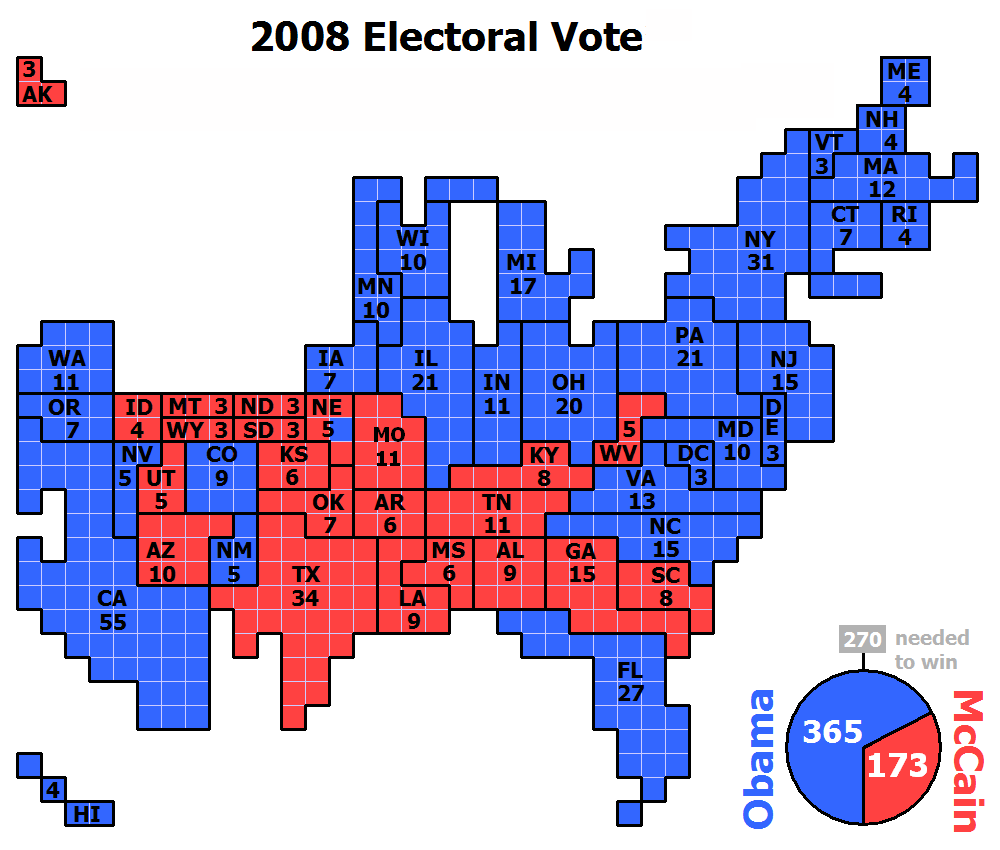
Looking at the map above you'd think we lived in a mostly red country. If we elected our president based on acreage that would be true. But we don't. We elect our president based on what seems to be an obsolete method laid out in our Constitution. But, like so many things, it's not that simple!

Before we get into it, here's another way of looking at the just concluded presidential election, based on the distribution of electoral votes.


(By the way, earlier in the campaign - before Obama took the lead in Virginia, North Carolina and Florida - I thought it was interesting comparing a map of who was leading where with a map of the North and South during the Civil War. The states where slavery was legal were for the Republicans and the states where slavery was outlawed were for Obama and the Democrats. Hmm.)

Back to the Electoral College.  Here in Texas, millions of people voted for Obama, without it having any effect on the electoral vote.  In fact, nationwide, he was elected by about 40 percent of the people who voted. Over 30 percent of the people who voted for Obama could have stayed home without having any effect on the electoral totals.  It was worse for the Republicans.  Nearly 70 percent of them could have stayed home!  

Maybe we should just dump this system and elect our presidents directly. The assumption is that, of course, the Electoral College was meant to implement the will of the People. After all, we are a Democracy, right? Well... Maybe the idea was to have Congress choose the president and vice president, but in a way that would balance the influence of the Congress, the states, and the people.

George Will has an article, The Final Repudiation, in the November 17th issue of Newsweek Magazine, where he talks about the presidential election process.  Will refers us to an article in the Claremont Review of Books by James W. Ceaser, a professor of politics at the University of Virginia, to make the case that the United States has actually utilized six presidential selection systems so far!

"The Founders’ presidential selection system, the first of six the nation has had so far, was feasible only when it was dispensable—in the first two elections, when George Washington was everyone’s preference. By the time he left office in 1797, political parties, which were not anticipated when the Constitution was drafted just 10 years earlier, were coalescing.

"Subsequent systems included: The selection of presidential candidates by the parties’ congressional caucuses (1796–1820); nonpartisan selection (1824–28); national nominating conventions controlled by parties’ organizations (1832–1908); a system of such conventions leavened by popular choice through a few state party primaries and caucuses (1912–68)—in 1968, Vice President Hubert Humphrey won the Democratic nomination without entering any primaries; since 1972, selection of nominees entirely by popular choice. Thus have conventions been reduced from deliberative bodies to mere ratifying bodies."

Ceaser's very interesting article, The Presidential Nomination Mess, makes the case that the founders were trying to avoid just the sort of process we have just been through.

"The founders' intent was above all to prevent having the decision turn on a demonstration of skill in the 'popular arts' as displayed in a campaign. They were deeply fearful of leaders deploying popular oratory as the means of winning distinction; this would open the door to demagoguery, which, as the ancients had shown, was the greatest threat to the maintenance of moderate popular government."
This has been a concern of mine since the Howard Dean campaign in 2004, when it first became apparent that a candidate could raise enough money, using the Internet, to be competitive without having to rely on contributions from those with larger financial stakes in the outcome of the election.

Confused yet?  I am.  I think this is probably "above my pay grade" as they say.

Here's a scary thought. Fabius Maximus thinks that the current financial crisis is going to require the country to assume new roles and powers such that that maybe it's time for the Constitution to go the way of the Articles of Confederation and be replaced by a 'Mark 3' Version of the United States!

Sunday, November 2, 2008

Other Voices


An interesting survey on The Republican Disconnect at the Democracy Corps website (by way of Paul Krugman). I'd love to see the Republican Party move away from anti-intellectual social conservatives and toward a more moderate-libertarian stance.  But, that may not happen.  And speaking of libertarians, Ron Paul demonstrated that the philosophy has a dedicated core following,  But where are they in the Pew Research Center's 2005 Political Typology report?  I'll be looking forward to a new report coming out of the 2008 elections.

And for those of you who just can't get enough, here are a couple more political links: the Poole-Rosenthal Voteview website (again by way of Paul Krugman) and The Green Papers.

Saturday, November 1, 2008

Yellow Dog Republicans


(updated below)

I drive through my neighborhood and am yet again amazed by all the McCain/Palin yard signs. What campaign have they been following? What are they thinking? It would be easier to just assume they were ignorant or crazy. But this is the South and there are so many of them.  And I know some of them - which makes it harder to demonize them. What are they thinking?

Maybe it's me that's out of step?  Maybe I shouldn't be deconstructing what the Republicans are saying.  Maybe if I'd grown up here and come from a long line of good conservatives, I wouldn't have to think.  Or, at least, I wouldn't have to think about the rhetoric.  I'd know who I was.

But, we live in a technological age of instant communication and widely cast virtual communities. I don't have to either integrate myself into the local dominant social order or be an outcast.  At the same time, there's still this tendency to want to see the world in terms of us and them.

"In spite of limitless opportunities for enriching understanding, adding potentials, and cocreating new worlds through the expanding arena of relationship, many people seem to vastly prefer using these technologies to cement their relationships with those who already share their ways of life. Certainly one can appreciate the sense of security and support to which such tendencies contribute, But the result has increasingly become a dangerous distancing. When congregating with others who already share one's realities and values, strong tendencies are unleashed for such groups to seal themselves off from the rest of the world, to develop a sense of a superior good, and to brand those outside the network as a problem if not downright evil. The technologies of saturation thus lend themselves to islands of self-righteousness in a sea of antagonism." - Kenneth J. Gergen, The Saturated Self
I'm tired. I'm ready for this election to be over.  I'm ready to move forward, get past being in a red state or a blue state, and get on with being part of the United States of America! Wouldn't that be nice? If only...

By the way, somebody stole my Obama/Biden yard sign again last night!

UPDATE: Gergen's The Saturated Self has a link to the Public Conversations Project website.  The site provides information and tools for facilitating dialog between groups or individuals separated by 'essentially contested concepts', including downloadable publications such as Fostering Dialog Across Divides and Reaching our across the Red/Blue Divide, One Person at a Time.