


Looking at the map above you'd think we lived in a mostly red country. If we elected our president based on acreage that would be true. But we don't. We elect our president based on what seems to be an obsolete method laid out in our Constitution. But, like so many things, it's not that simple!
Before we get into it, here's another way of looking at the just concluded presidential election, based on the distribution of electoral votes.
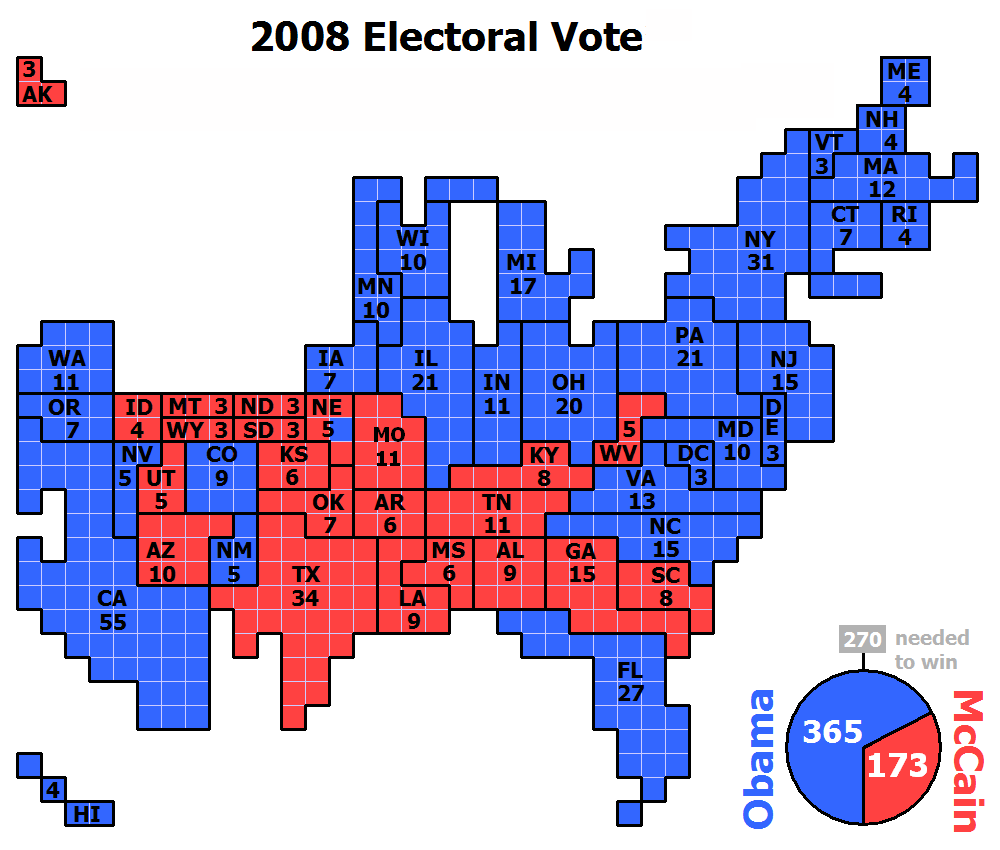
(By the way, earlier in the campaign - before Obama took the lead in Virginia, North Carolina and Florida - I thought it was interesting comparing a map of who was leading where with a map of the North and South during the Civil War. The states where slavery was legal were for the Republicans and the states where slavery was outlawed were for Obama and the Democrats. Hmm.)
Back to the Electoral College. Here in Texas, millions of people voted for Obama, without it having any effect on the electoral vote. In fact, nationwide, he was elected by about 40 percent of the people who voted. Over 30 percent of the people who voted for Obama could have stayed home without having any effect on the electoral totals. It was worse for the Republicans. Nearly 70 percent of them could have stayed home!
Maybe we should just dump this system and elect our presidents directly. The assumption is that, of course, the Electoral College was meant to implement the will of the People. After all, we are a Democracy, right? Well... Maybe the idea was to have Congress choose the president and vice president, but in a way that would balance the influence of the Congress, the states, and the people.
George Will has an article, The Final Repudiation, in the November 17th issue of Newsweek Magazine, where he talks about the presidential election process. Will refers us to an article in the Claremont Review of Books by James W. Ceaser, a professor of politics at the University of Virginia, to make the case that the United States has actually utilized six presidential selection systems so far!
"The Founders’ presidential selection system, the first of six the nation has had so far, was feasible only when it was dispensable—in the first two elections, when George Washington was everyone’s preference. By the time he left office in 1797, political parties, which were not anticipated when the Constitution was drafted just 10 years earlier, were coalescing."Subsequent systems included: The selection of presidential candidates by the parties’ congressional caucuses (1796–1820); nonpartisan selection (1824–28); national nominating conventions controlled by parties’ organizations (1832–1908); a system of such conventions leavened by popular choice through a few state party primaries and caucuses (1912–68)—in 1968, Vice President Hubert Humphrey won the Democratic nomination without entering any primaries; since 1972, selection of nominees entirely by popular choice. Thus have conventions been reduced from deliberative bodies to mere ratifying bodies."
Ceaser's very interesting article, The Presidential Nomination Mess, makes the case that the founders were trying to avoid just the sort of process we have just been through.
"The founders' intent was above all to prevent having the decision turn on a demonstration of skill in the 'popular arts' as displayed in a campaign. They were deeply fearful of leaders deploying popular oratory as the means of winning distinction; this would open the door to demagoguery, which, as the ancients had shown, was the greatest threat to the maintenance of moderate popular government."
This has been a concern of mine since the Howard Dean campaign in 2004, when it first became apparent that a candidate could raise enough money, using the Internet, to be competitive without having to rely on contributions from those with larger financial stakes in the outcome of the election.
Confused yet? I am. I think this is probably "above my pay grade" as they say.
Here's a scary thought. Fabius Maximus thinks that the current financial crisis is going to require the country to assume new roles and powers such that that maybe it's time for the Constitution to go the way of the Articles of Confederation and be replaced by a 'Mark 3' Version of the United States!
No comments:
Post a Comment