Wednesday, December 17, 2008

Other Voices


Leigh Caldwell on his Knowing and Making blog, provides some analysis of How Much Blagojevich SHOULD have asked for?  After all, how much is a U.S. Senate seat worth? And what is the discount for the risk of discovery?

We've all grown pretty accustomed to obfuscation, and outright lying from our political leaders and other's trying to sell us something. So which economists should we trust when it comes to understanding our current financial crisis with all the money being handed out? Need help? Check out the Economist Rankings at IDEAS. Let's see, Paul Krugman is ranked 15th. Nuriel Roubini is 403rd! (Hmm, maybe I'd better stop listening to him.) Larry Summers is 12th. Good. Glad I don't have to worry about that anymore! I forgot to mention, Joseph Stiglitz is ranked number one.

One more voice I want to recommend is that of Jeffrey Sachs. I particularly liked his article on the American Anti-Intellectual Threat, published in September on Project Syndicate.

Saturday, December 13, 2008

a Trillion Here, a Trillion There...


(updated below)

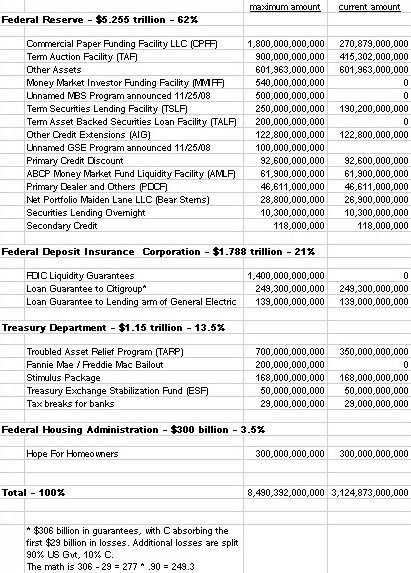
It's hard for me to wrap my mind around the dollar amounts involved in the financial rescue/bailout. In one sense, they're just numbers. But the thing that's finally gotten me thinking about how much money we're talking about, is thinking about the discussions we used to have about the money being spent on the war in Iraq.

In addition to lives and families lost and wrecked, we mourned the better uses that money could have been put to—universal healthcare, energy independence. (Never mind that the money we spent in Iraq was borrowed and wasn't really available for alternative projects.) But now, compared to the money we're giving financial institutions, that amount pales.

The above is already out of date.  The $4.6 trillion was as of November. (From The Big Picture. by way of mindtangle.) I've seen the figure estimated as high as $7.4 trillion. Every day, that number will be more and more out of date. Wait, here's yet a higher number already!

I am going to have to find some time when I can quiet my mind and try to find an explanation for what happened that requires all this money to fix. (I expect the place to start may be Wikipedia's article on the Subprime Mortgage Crisis Housing Bubble.)

UPDATE: I want to add a couple of links I found trying to put the cost of the Iraq War in perspective. The first, is a graph comparing Iraq war spending vs. spending on renewable energy from Solar Power Rocks! (The chart is too big to fit on this page!) Another link, from Ted Kennedy, put's the Real Cost of the War in Iraq in perspective by comparing the cost of one day of war expenditures to what that money could buy.

Sunday, December 7, 2008

Car Bombs!


Here's an idea! We buy up a bunch of cars from the Big Three automakers, load them up in bombers, and drop them on our enemies in Iraq and on the Afghanistan-Pakistan border—car bombs!

The cars that aren't completely destroyed when they fall on the terrorists—they can fix up and drive. This will help promote our modern way of life—and they'll have to build roads and buy spare parts from our auto parts stores! We bail out the auto industry, kill some terrorists, and spread good old American Capitalism! Everybody wins! (Except for the evil terrorists, of course.)

I mean, we're going to have to do something with all the cars Detroit will be making. We could condition the bailouts on not building cars—like agriculture subsidies, where we pay the farmer not to grow their crop this year. But, the problem with this is that it doesn't help the dealerships or the industries that supply the parts and materials to make the cars. To solve the economic problem of the automakers—and all those other businesses—we have to come up with a solution where they keep making cars.

So, if we're not going to have the military buy them up and drop them out of bombers, what are we going to do with them. I guess the government could buy them and give them away to people who deserve a new car, but just can't afford to buy one. (But that sounds like a potentially serious ethical conundrum!)  

I know! We can give them to veterans! Or, we can give them to people who're homeless, 'cause they defaulted on their subprime mortgages. There might be some retooling required—like making sure the seats will lie flat for sleeping. (While we're at it, we could replace the cigarette lighters with toilet paper holders.)

If none of these ideas succeeds maybe we can at least give tax credits to people for buying American-made cars. Like we did for energy efficient vehicles through the Energy Policy Act of 2005. (Unless there's some anti-protectionism rule against helping American automakers.) Plus, we could ease the credit blockage by offering some kind of guarantee to banks making the loans to the people buying the cars.

Saturday, December 6, 2008

Suspicious Statistics


Paul Krugman has a chart from the U.S. Department of Labor, Bureau of Labor Statistics showing the ratio of civilian employment to population (EMRATIO) on his Conscience of a Liberal blog today.

"The chart above shows the employment-population ratio,  the ratio of employed Americans to the adult population. By this measure it’s been a weak economy all along — and now it’s falling off a cliff."
One of the first things that strikes me about this graph is the range of employment percentage (Y-axis). If the chart showed the percentage fluctuation in the context of zero to one hundred percent employment, the variation would look pretty minimal. And why are we looking at only ten years?

So I went out to the Federal Reserve Bank of St. Louis website to see what else I could find.  Sure enough, here's the same chart, but showing employment since the 1940's.

This picture seems to tell a different story! But now you have to take into account that women were joining the workforce in greater numbers during this period.  (In fact, given the relatively narrow percentage range, I surprised the increase isn't greater.)

Here's another period to look at—the last two administrations.

What do you think? Do Clinton and the Democrats get credit for the first half of the period? The Republican congress? Do Bush and the Republicans get the blame for the last half? Whose fault were the two burst bubbles?

So, I started this suspicious of Dr. Krugman for cherry-picking data to support his position. After thinking about it, I'm not so suspicious of him. I'm suspicious of statistics! It's not trivial to avoid making them say what you want them to say.